

This is our news scan from 31 October 2026 at 0753 Eastern Time until 1 Nov 2026 at 0601 Eastern Time
Shock Line
Four tankers strike mines in Hormuz while Iran orders unrestricted response to any new strikes.
What Changed (Last 24 Hours)
Qatari mediators held more than twelve hours of talks with Iranian officials in Tehran aimed at restarting direct US-Iran negotiations, with sessions set to continue in Doha.
Iran’s IRGC Navy stated that four oil tankers, including a supertanker carrying more than two million barrels, struck mines and caught fire in the Strait of Hormuz near the Omani coast after using unauthorized routes; Oman evacuated twenty-five crew from a Panama-flagged tanker.
Supreme Leader Mojtaba Khamenei directed military chiefs to answer any attack with an immediate, impactful, and geographically unrestricted response and to update the target bank covering all tangible and intangible US and Israeli assets.
OPEC+ core members agreed in principle to keep December oil output targets unchanged.
Russia extended its general ban on diesel exports by producers through the end of January.
Binance replenished 90% of assets stolen in a $6.3 billion hack by drawing on its user protection fund, futures insurance, and corporate treasury.
China’s upgraded free-trade agreement with Peru took effect, expanding rules on e-commerce, global supply chains, competition policy, and the environment.
The Line to Remember
Physical interdiction of a chokepoint forces diplomatic and military timelines onto the same clock.
Black Swan Watch: Analysts are not yet pricing the possibility that the limpet-mine and contact-mine incidents mark a durable tactical shift rather than opportunistic strikes.

Why You Should Upgrade to Paid:
Know what matters before everyone else understands why it matters.
Before the pitch, the reason this publication exists. Every dollar of paid subscriptions here is donated to Angel Flight East. Paid readers fund free flights that carry cancer patients to treatment they cannot reach any other way. Your upgrade is not a tip jar. It puts a patient in a seat.
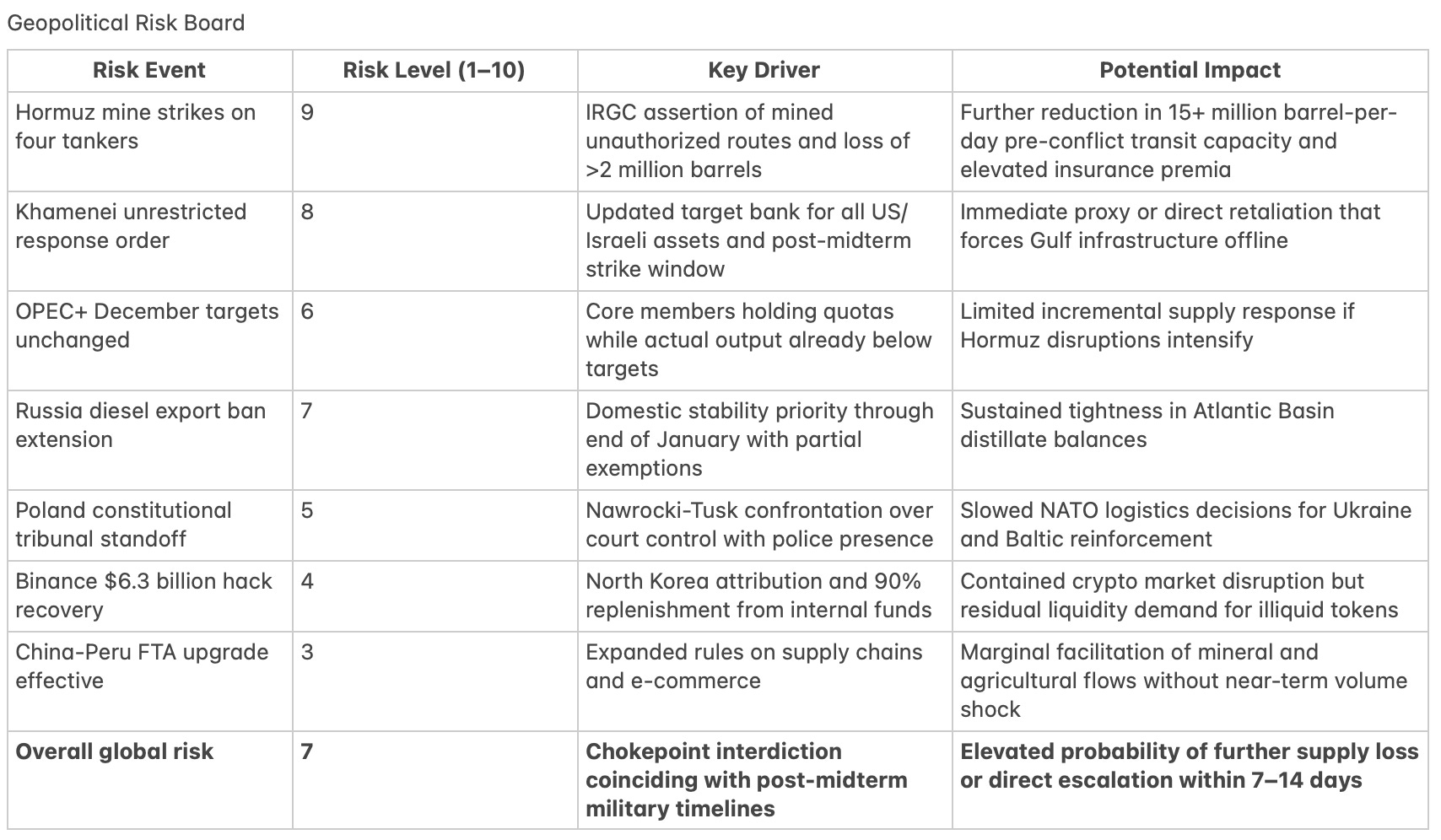
Today’s paid briefing leads with Hormuz mine strikes on four tankers. The Geopolitical Risk Scoreboard moved the overall global risk rating to 7 out of 10, and the free section above does not tell you why, or what it hits next.
Inside today’s Rapid Read Intelligence Briefing:
The full Geopolitical Risk Scoreboard: every major risk event scored 1 to 10, the driver behind each score, and the overall global risk rating for today.
Market Summaries and Why They Move: energy, equities, metals, shipping, and industrial commodities, including what actually moved prices in the last 24 hours.
What We Should All Be Watching and Why: the short list of developments most likely to break next, and the signals that confirm them.
The contrarian take and the Black Swan watch: the scenario the consensus is ignoring, and the low probability event that would change everything overnight.
This edition condenses 12 news stories and 6 Substack articles into one briefing.
Founding Members give $300 a year. Full membership is $95 a year, or $9 a month. About 24,000 people follow the free Rapid Read. The paid briefing is where the full picture lives, and every dollar of it funds Angel Flight East missions. Join, get the whole briefing, and put a patient in a seat.


Rapid Read Intelligence Briefing
Geopolitical Risk Board
Why This Matters (The System)
Security-First Energy Regime. Mine strikes on four tankers in the Strait of Hormuz, including one carrying more than two million barrels, occurred while Iran’s IRGC asserted control over unauthorized southern routes and Supreme Leader Mojtaba Khamenei ordered an immediate, geographically unrestricted response to any new attack. Qatari mediators spent more than twelve hours in Tehran seeking to restart direct US-Iran talks that will continue in Doha. The operating system shifted from contested transit to active denial of the primary global oil artery under parallel military and diplomatic clocks.
Hard anchor: Hormuz flows have already fallen to roughly half of pre-conflict baseline levels near 8.7 million barrels per day, with one supertanker incident alone removing more than two million barrels from the market.
What Breaks Next (Forward Risk)
If the IRGC’s claim of mined unauthorized routes holds and additional vessels avoid the southern corridor, the Brent-WTI spread widens further beyond the current $13+ differential as Atlantic barrels remain trapped by freight while Gulf barrels command scarcity premiums.
If Khamenei’s unrestricted target-bank update activates proxies or expands to intangible assets, optionality for Gulf producers collapses because insurance and escort capacity cannot scale faster than the physical risk of limpet or contact mines.
First-mover advantage accrues to refiners and traders who secured non-Gulf barrels or alternative routes before the latest mine reports; those still reliant on Hormuz-adjacent loadings face demurrage and rerouting delays measured in days to weeks.
Second-order geopolitical consequence: post-midterm US strike windows compress because Khamenei’s order places any attack on an immediate-response timeline that Gulf allies have already been told to expect as early as November 4.
Infrastructure and contract limits bind speed. VLCC repositioning from Atlantic discharge points requires multi-week ballast voyages, and existing term contracts for December loadings cannot be rewritten without force-majeure triggers that insurers have not yet broadly accepted.
Non-energy: Poland’s constitutional crisis, with President Nawrocki returning mid-flight and forcing entry to the tribunal amid police lines, degrades decision speed in a primary NATO logistics hub for Ukraine aid and Baltic defense.
Non-energy: Binance’s 90% replenishment of the $6.3 billion North Korea-attributed theft from internal funds and user-protection reserves shows that large-scale crypto infrastructure can absorb state-linked theft without immediate user loss, but residual less-liquid tokens still require market purchases that can move prices.
Signal vs. Noise
Signal
Four tankers, including a supertanker with more than two million barrels, reported as hitting mines on unauthorized Hormuz routes with Oman evacuating 25 crew.
Khamenei directive for immediate, impactful, geographically unrestricted response and updated target bank covering all tangible and intangible US and Israeli assets.
OPEC+ core members agreement in principle to hold December output targets unchanged while Gulf producers already pump below quotas due to war disruptions.
Russia’s extension of the producer diesel-export ban through the end of January, with limited exemptions still expected.
Qatari mediation sessions exceeding twelve hours in Tehran with continuation set for Doha.
Noise
China-Peru upgraded free-trade agreement taking effect; commercial rules expand but do not alter physical energy or security constraints in the next 30 days.
Oil majors directing third-quarter windfall profits (combined net income exceeding $50 billion) toward buybacks and debt reduction rather than greenfield refineries; long-term capacity timelines already measured in years.
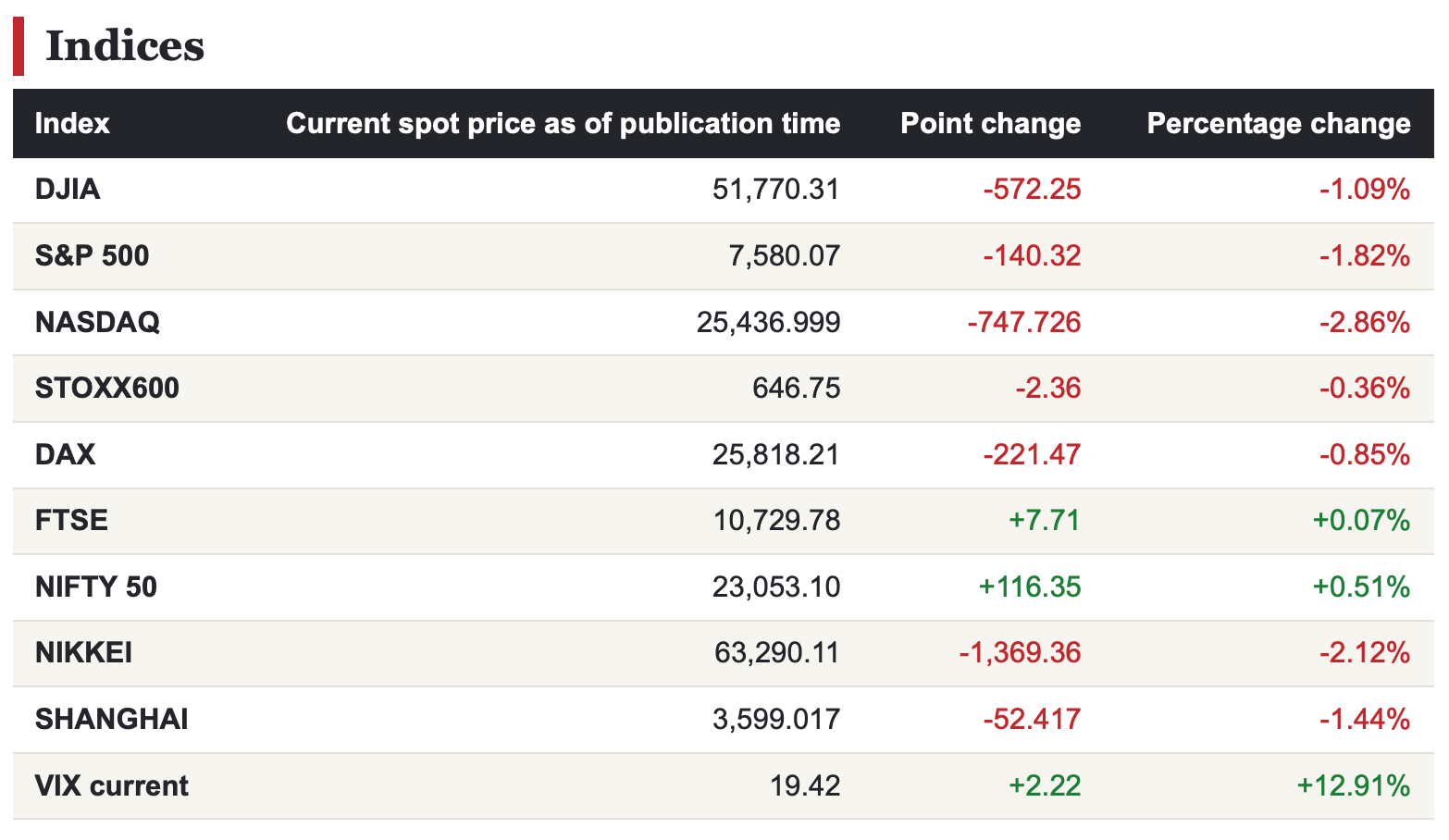
Routine equity index declines and VIX rise to 19.42; price action reflects existing risk premia rather than new constraint changes.
Market Summaries and Why They Move
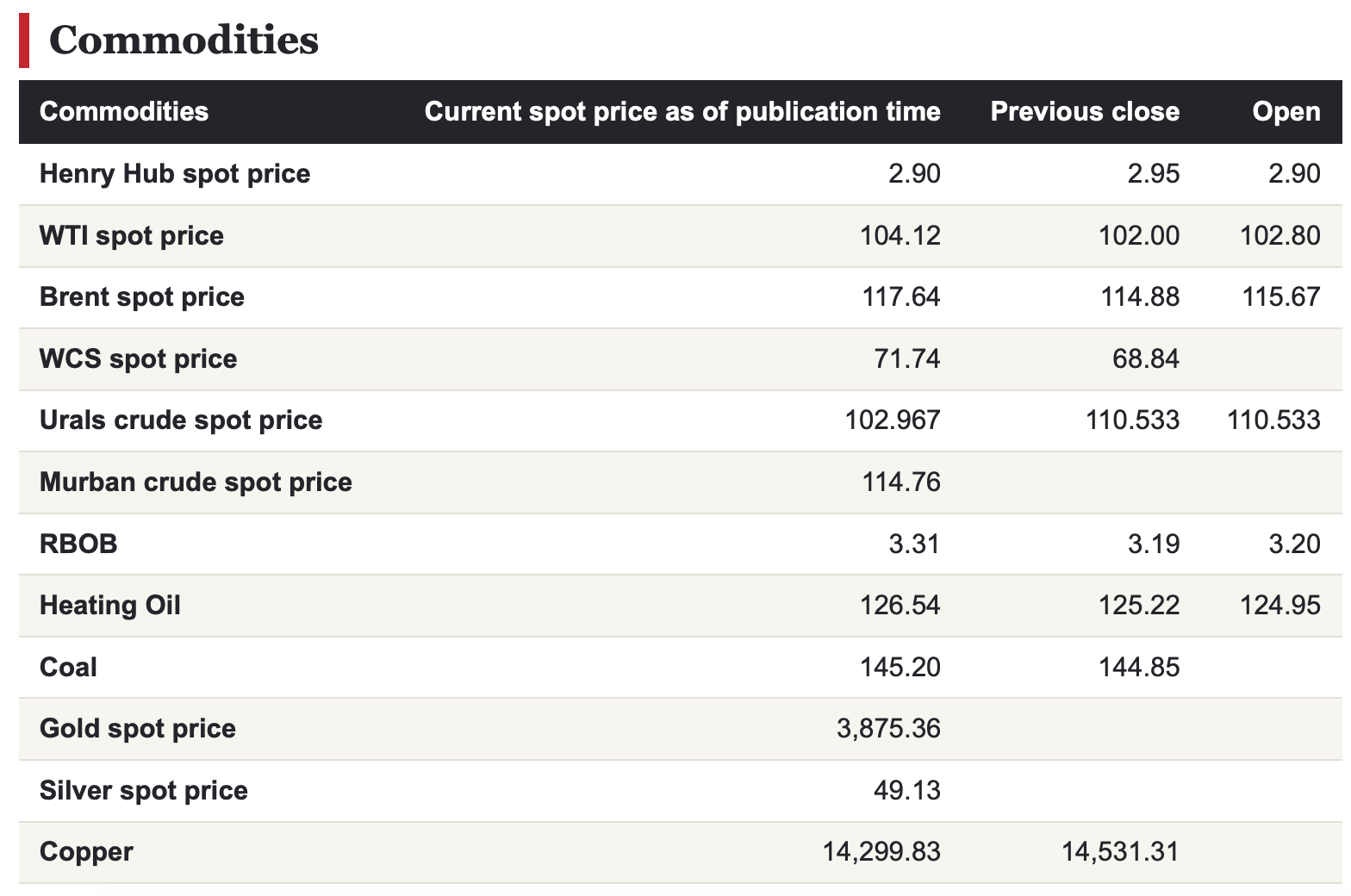
Energy commodities priced the physical constraint rather than the diplomatic activity. WTI settled at $104.12 and Brent at $117.64, reflecting the addition of confirmed or claimed mine damage to already-reduced Hormuz volumes. The Brent-WTI spread near $13.5 captures the relative scarcity of seaborne Middle East barrels versus landlocked or Atlantic alternatives that cannot be repositioned quickly. Urals traded near $103 while WCS held at $71.74, the discount to WTI remaining wide because Canadian barrels face pipeline and refining bottlenecks unrelated to the Strait. Murban at $114.76 tracked the Gulf premium. Henry Hub at $2.90 showed no material response because US LNG export capacity is already near full and cannot absorb additional foreign demand. Crack spreads remained elevated: the 3-2-1 refining margin proxy stayed near $50 per barrel while diesel cracks approached or exceeded $100 per barrel in recent sessions. These figures matter because roughly 10% of global refining capacity is offline from the Iran war and Ukrainian strikes on Russian plants; the remaining units capture the margin between expensive crude and scarce products, and the diesel crack specifically signals that industrial and transport fuels are tighter than gasoline. High cracks incentivize maximum utilization of operable capacity but cannot create new barrels of diesel when feedstocks and freight are both constrained.
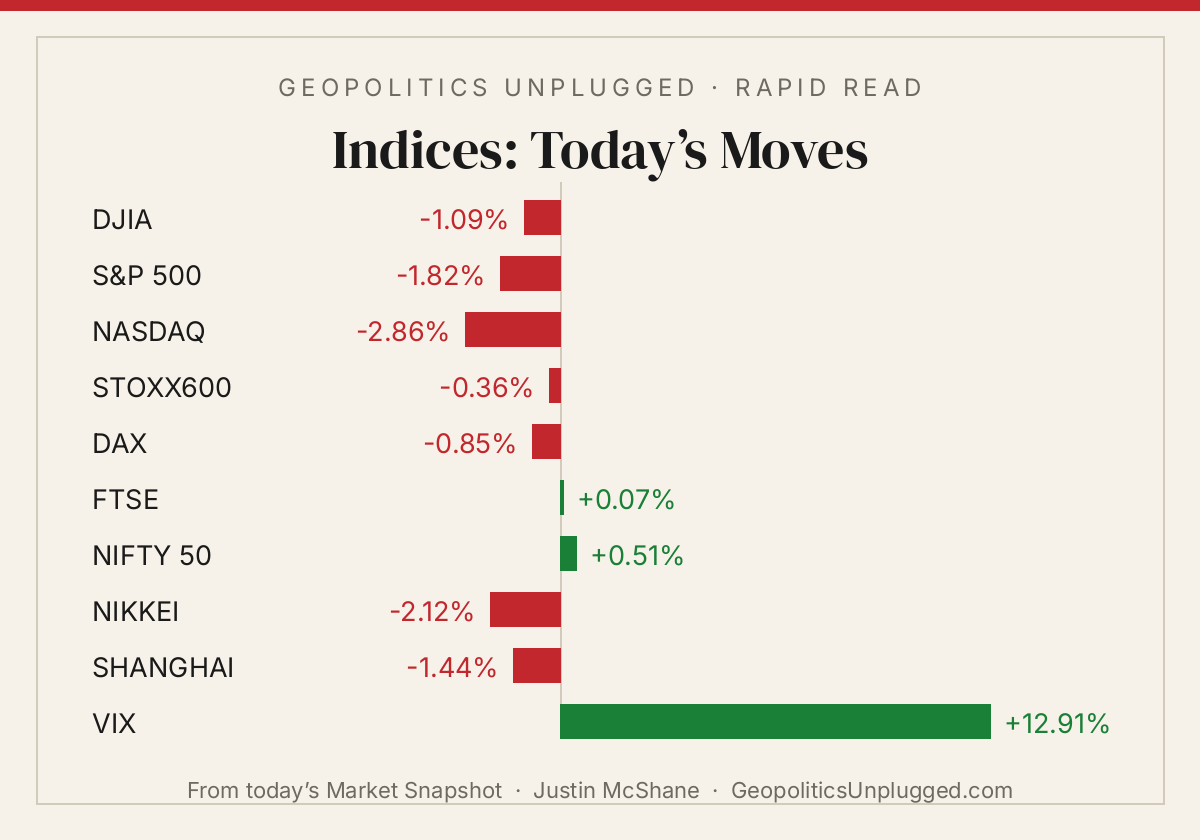
Broader equity indices declined on the same physical risk. The Dow fell 1.09% to 51,770.31, the S&P 500 dropped 1.82% to 7,580.07, and the Nasdaq lost 2.86% to 25,436.999 as the VIX rose 12.91% to 19.42. Gold held near $3,875 and silver near $49.13, consistent with elevated geopolitical premia rather than pure financial stress. Copper eased to $14,299.83 from $14,531.31, reflecting both risk-off positioning and the recognition that sustained high energy and freight costs raise the delivered price of industrial metals without immediately altering mine supply. The equity and metals moves are second-order reactions to the same Hormuz interdiction that lifted crude; they do not yet price a full escalation of the target-bank response ordered by Khamenei.
Shipping rates continue to function as the leading indicator. VLCC freight on Middle East-to-Asia routes remains at levels that add tens of dollars per barrel to delivered crude cost, with recent assessments showing TCEs well above $400,000 per day even after modest easing from earlier peaks. Tanker rates rose before and alongside the crude price spike because the mine reports reduced effective transit capacity and forced longer routing or waiting. Container rates have not shown comparable acute spikes in the last 24 hours, but the tanker move already prices the physical bottleneck that will appear in later trade data. Charterers who delayed fixing now face both higher absolute rates and reduced vessel availability as owners prioritize shorter, higher-yielding legs.
Oil and natural gas flows in the last 24 hours were shaped by the continued effect of the Hormuz incidents and the policy decisions that followed. The IRGC-reported mine strikes on four tankers, one carrying more than two million barrels, removed that volume from the market or rendered it unusable while the vessels burned or were disabled near the Omani coast; Oman’s evacuation of 25 crew from a Panama-flagged tanker confirmed physical damage even if full attribution remains contested. No new major production volumes came online. Russia’s formal extension of the producer diesel-export ban through the end of January locks in the existing reduction of Baltic and Black Sea product exports, with only limited exemptions expected to reach roughly 2.15 million tons in November. OPEC+ core members’ decision to leave December targets unchanged means Gulf producers will not attempt to offset the Hormuz losses through higher quotas; most are already producing below targets because of the same war-related disruptions. Reliance Industries continued to redirect diesel and jet fuel volumes toward Africa, the Mediterranean, and other European markets, raising its share in those regions by about 50% in the prior quarter, but these are reallocations of existing Indian refining output rather than net new barrels. No significant new natural gas flows or LNG cargoes were reported as added or throttled in the period.
Industrial commodities showed no acute physical disruptions in the last 24 hours that alter near-term balances. Tungsten’s elevation on a critical-minerals watchlist underscores its defense and industrial concentration risk, yet no mine outages, export-control changes, or price spikes were recorded in the window. Rare earths, germanium, cobalt, vanadium, molybdenum, titanium, and niobium likewise registered no verified supply-chain events or policy announcements that would move physical availability within days. Longer-term concentration risks remain, but they did not generate a market-moving constraint in the past day.
What We Should All Be Watching and Why
The coincidence of physical interdiction in the Strait of Hormuz with an explicit order for unrestricted retaliation places the global energy system on a compressed timeline that cannot be separated from the US midterm calendar. Four tankers, including a supertanker loaded with more than two million barrels, were reported by Iran’s IRGC as having struck mines while using routes Tehran deems unauthorized; Oman’s evacuation of 25 crew members from a Panama-flagged vessel provides independent confirmation of damage even while full verification of cause remains incomplete. Simultaneously, Supreme Leader Mojtaba Khamenei directed military chiefs to answer any attack with an immediate, impactful, and geographically unrestricted response and to update the target bank covering all tangible and intangible US and Israeli assets. Qatari mediators conducted more than twelve hours of talks in Tehran aimed at restarting direct negotiations, with sessions scheduled to continue in Doha, yet Foreign Minister Abbas Araghchi conditioned progress on sanctions relief and a reduced US regional presence. These developments warrant close monitoring because the physical constraint (reduced Hormuz transit already near half of baseline) and the military directive now operate on the same clock. Any post-November 3 US strike window that Gulf allies have been told to expect would, under Khamenei’s order, trigger an immediate response whose geographic scope is no longer limited to the theater. Policymakers on both sides are boxed in: the US administration has publicly ruled out strikes before the midterms while building forces and notifying partners, while Iran has removed the option of limited, geographically contained retaliation.
Second-order effects include further erosion of insurance capacity for any Gulf loading, accelerated draws on already-tight distillate inventories, and reduced optionality for refiners that have not yet secured alternative feedstocks. Who loses optionality first are the traders and refiners holding December cargoes that still require Hormuz transit or that lack force-majeure language covering mine strikes; owners of vessels currently ballasting toward the Gulf face multi-week delays if they elect to wait for clearer routing. Indicators to watch in the next 7–30 days include the outcome of the Doha continuation of Qatari mediation, any additional UKMTO or IRGC statements confirming or expanding mine incidents, movements of the three US carrier groups already in or approaching the region, statements from Gulf energy ministries on loading schedules, and changes in VLCC freight and insurance premia. De-escalation would appear as a verified pause in mine or projectile incidents combined with a joint statement on transit protocols; escalation would appear as a confirmed strike on additional tankers or activation of the updated target bank. Outside energy, Poland’s constitutional tribunal confrontation, with
President Nawrocki returning from a Senegal flight and entering the court amid police lines after the suspension of the tribunal president, is geopolitically significant because Poland remains the primary logistics corridor for military aid to Ukraine and the forward basing area for NATO reinforcement of the Baltics. Institutional paralysis in Warsaw slows emergency decision cycles even while Article 5 commitments formally remain intact, creating a secondary vulnerability that Russia can exploit if the Hormuz crisis absorbs US attention.
Contrarian Take
The consensus treats the Hormuz mine reports as an unambiguous supply shock that must lift prices until diplomacy intervenes, yet the IRGC’s own framing attributes the incidents to vessels that disabled navigation systems and ignored warnings on routes Tehran has long declared off-limits. If the southern corridor is in fact mined as claimed, the incremental loss is concentrated among owners who already accepted elevated risk rather than a sudden closure of the primary escorted lanes. OPEC+’s decision to hold December targets unchanged is being read as a failure to respond, but Gulf producers are already pumping below those targets because of the same war-related constraints; the quota hold simply avoids the appearance of adding barrels that cannot physically move. Russia’s diesel-ban extension is viewed as pure tightness, yet the accompanying statement that limited exemptions will still allow roughly 2.15 million tons in November indicates the policy is calibrated to domestic stability rather than a maximal export cut. Equity and metals weakness is interpreted as broad risk-off, yet the magnitude remains modest relative to the crude move, suggesting markets are pricing the known freight and insurance costs rather than an imminent full-scale exchange. Finally, the Qatari mediation is dismissed as theater, but twelve continuous hours in Tehran followed by a scheduled Doha continuation is a longer and more structured engagement than the collapsed June pause, and it occurs while both sides still have public incentives to avoid an immediate post-midterm spiral.
Black Swan Analysis
Analysts are not yet pricing the possibility that the limpet-mine and contact-mine incidents mark a durable tactical shift rather than opportunistic strikes. The first confirmed use of limpet mines on a tanker hull in the region since 2019, reported by multiple maritime security sources on a vessel that continued under its own power after the engine-room fire, indicates that small-craft teams can now approach, attach, and withdraw in congested lanes without requiring larger platforms. If this method scales, the requirement for continuous surface escorts or air cover rises sharply because detection windows shrink from minutes to seconds. A second under-discussed risk is the interaction between Poland’s institutional standoff and any US decision to reallocate air-defense or logistics assets toward the Gulf after November 3. Warsaw’s current paralysis does not affect day-to-day military operations, but it lengthens the timeline for emergency basing or transit approvals precisely when those approvals would be needed to backfill any Mediterranean or European assets moved east. Neither development is mainstream yet because verification of the mine tactics remains incomplete and the Polish crisis is still framed as domestic politics; both, however, are visible in primary reporting from the last 24 hours and would, if confirmed, remove residual optionality faster than markets currently assume.
Market Snapshot (Current as to Time of Publication not to be relied upon for trading purposes):
Sources:
Qatari mediators held talks in Tehran aimed at restarting direct U.S.-Iran negotiations, source says
https://www.cnbc.com/2026/10/31/qatar-iran-us-talks-mediation.html
Qatari mediators spent more than twelve hours in talks with Iranian officials in Tehran on Friday seeking to restart direct U.S.-Iran negotiations and avert post-midterm attacks. Discussions are set to continue in Doha, although Foreign Minister Abbas Araghchi denied plans to meet U.S. officials and called such reports speculation. A June agreement to pause fighting that started with February 28 strikes later collapsed, and President Trump has said he will end the war on his terms while demanding a complete nuclear guarantee. Khamenei ordered an immediate unrestricted response to any new strikes as Hormuz incidents lifted oil prices.
‘Supertanker’ strikes mine in Hormuz, losing two million barrels of oil
https://www.abc.net.au/news/2026-10-31/four-tankers-strike-mines-in-strait-of-hormuz/107332392
Iran’s Revolutionary Guard stated that four oil tankers, including a supertanker carrying over two million barrels, struck mines and caught fire while using unauthorized routes through the Strait of Hormuz near the Omani coast. The IRGC claimed the vessels disabled navigation systems and ignored warnings. Oman evacuated twenty-five crew from a Panama-flagged tanker that caught fire off Musandam, though linkage to the Iranian reports is unclear. UK Maritime Trade Operations also recorded a vessel hit by an unknown projectile south of Lavan, adding to attacks that continue to threaten the vital shipping lane.
Iranian military ordered to counter any attack swiftly and without restraint
Supreme Leader Mojtaba Khamenei directed military chiefs to answer any attack with an immediate, impactful, and geographically unrestricted response, indicating plans to expand targets and activate proxies including Hezbollah and Hamas. The orders require updating the targets bank to cover all tangible and intangible U.S. and Israeli assets. They were issued as reports circulated that Gulf allies expect a possible new U.S. assault as early as November 4 after the midterms. Qatari mediation continues in parallel, with Foreign Minister Araghchi calling dialogue positive but conditioning progress on sanctions relief and a reduced U.S. regional presence.
Iran’s Supreme Leader threatens US with response if strikes are launched after midterms
https://thehill.com/policy/international/6186134-khamenei-warns-iran-strikes/
Supreme Leader Mojtaba Khamenei warned that post-midterm U.S. strikes would trigger an immediate impactful response without geographic limits and ordered updates to the target database covering all U.S. and Israeli assets. Outlets reported that Washington notified Arab states to prepare for a short campaign possibly starting the day after the November 3 elections. President Trump had pledged no strikes before the midterms amid pressure over energy costs from the war that began February 28 and has cost about forty-seven billion dollars. The administration has also pursued economic isolation through sanctions and a Hormuz blockade.
Binance recovers 90 percent of stolen assets from hack
https://thehill.com/policy/technology/6186304-binance-replenishes-ninety-percent-hack/
Binance reported that it replenished ninety percent of assets stolen in a six-point-three-billion-dollar hack by drawing on its user protection fund, futures insurance, and corporate treasury. The exchange halted deposits and withdrawals after wallet outflows began Thursday and affirmed that major coins remain fully backed while it sources remaining less-liquid tokens to reach full coverage. The company stated it will absorb the losses rather than charge users. President Trump said the administration is investigating the incident, which analysts have linked to a North Korean group, though no official attribution has been confirmed.
U.S. Intelligence: China Could Put Laser Weapons in Space by 2030
A U.S. Defense Intelligence Agency report warns that China could field space-based directed-energy weapons by the end of the 2020s and already has ground-based systems able to disrupt satellites beyond low Earth orbit. The assessment provides the first official U.S. government timeline for such capabilities and includes an image of a Chinese reusable spaceplane. Some analysts doubt China will deploy orbital lasers so soon, though Beijing has highlighted laser weapons progress. China dismissed the findings as hype while advancing its own space buildup, and U.S. Space Force leaders stress satellite survivability now equals performance because no safe harbor exists in orbit.
Iran’s IRGC Navy Says Four Tankers Catch Fire In Strait Of Hormuz
https://gcaptain.com/irans-irgc-navy-says-four-tankers-catch-fire-in-strait-of-hormuz/
Iran’s Revolutionary Guards Navy reported that four oil tankers caught fire and exploded in the Strait of Hormuz after using unauthorized routes, with one carrying more than two million barrels of crude hitting a mine. Reuters could not immediately verify the claims. The United Kingdom Maritime Trade Operations separately logged tankers struck by unknown projectiles, including one forty nautical miles south of Lavan Island, with crews safe. Tensions remain high since late-February strikes, and Iran claimed to have downed a U.S. drone and destroyed an unmanned vessel, though Centcom denied the latter.
OPEC+ agrees in principle to keep oil output targets steady in December, sources say
https://www.cnbc.com/2026/10/31/opec-oil-output-targets-december.html
OPEC+ core members agreed in principle to keep December oil output targets unchanged at a Sunday meeting, according to three sources. The decision matches expectations that further adjustments will wait until next year while the group focuses on 2027 quota talks and a capacity review. Gulf producers continue pumping below targets amid Iran-war disruptions even as they boost exports. Oil prices had risen more than two percent on Friday to their highest levels since April, with Brent and WTI near $117 and $104 amid rising tensions.
Reliance Industries expands fuel exports to Africa, Europe as West Asia conflict disrupts supplies
Reliance Industries redirected fuel exports to East and South Africa, the Mediterranean, and other European markets to capitalize on West Asia conflict disruptions, lifting its share in those regions by about fifty percent in the September quarter. It also supplied low-sulfur aviation turbine fuel to South Africa for the first time and boosted diesel and jet fuel shipments to the Mediterranean. Its oil-to-chemicals business drove strong results, with EBITDA up sixty-eight percent amid a forty-one percent rise in crude prices and sharp jumps in fuel cracks. Reliance maintained high utilization by adjusting crude sourcing and deploying extra vessels to offset higher freight.
Russia Extends Ban On Most Diesel Exports Through January
https://gcaptain.com/russia-extends-ban-on-most-diesel-exports-through-january/
Russia’s government extended a general ban on diesel exports by producers through the end of January to maintain domestic fuel market stability, while preparing exemptions that will allow certain volumes to reach global markets. Deputy Prime Minister Alexander Novak indicated that November exports could reach about 2.15 million tons after limited shipments this month. The ban had been relaxed earlier following discussions with the United States, though Ukrainian attacks on Russian refineries may modestly reduce available volumes. As of late October, only four tankers had departed Baltic ports with Russian diesel.
China’s ‘Upgraded’ Peru Trade Deal Takes Effect, Widening Ties
China’s upgraded free-trade agreement with Peru took effect on Sunday, expanding rules in areas including e-commerce, global supply chains, competition policy, and the environment, according to China’s Ministry of Commerce. The two countries signed the upgrade protocol in November 2024 after negotiations that began six years earlier. They also agreed to begin talks on negative lists for trade in services and investment within two years of the protocol taking effect, further widening bilateral economic ties.
Oil majors resist pressure to invest in new refineries as fuel prices keep rising
https://www.ft.com/content/4d63f08d-3556-4d84-8e1d-40f866741d15?syn-25a6b1a6=1
Oil majors including ExxonMobil, Chevron, BP, Shell, and TotalEnergies have directed war-driven windfall profits toward shareholder buybacks and debt reduction rather than new refineries, despite political calls to expand Western capacity. The companies posted combined third-quarter net income exceeding fifty billion dollars as fuel prices stayed near record highs and refining units ran near full capacity. About ten percent of global refining capacity has been offline this year due to the Iran war and Ukrainian attacks, and the IEA expects the diesel shortage to last into 2027. Analysts note long-term demand declines make costly greenfield plants unattractive given multi-year timelines.
Substack Articles (not necessarily news but got our attention and provoked us to think)
EP234: $100 Oil Redux: Where Are We In The Current Era?

Oil markets are trading near $100 per barrel again, prompting Arjun Murti to assess the current Geopolitical Super Vol era versus earlier high-price episodes like the 2022-23 recovery and conflict start. Back-end prices stay anchored at a sensible $65-70, while year-five persistent backwardation has invalidated oil-glut forecasts even as steep-curve pullbacks remain inevitable. Investors are slowly moving from assuming energy firms will waste money toward accepting that traditional companies can deliver competitive returns with suitable models and assets. Weightings in energy, power, and key minerals can still about double, with much of the healthy profitability and growth phase still ahead.
Market Wrap 31/10/2026 – Is the AI Trade Starting to Crack?

Friday’s session wiped out roughly $1 trillion as technology and AI stocks sold off, supporting the view that equities may correct 10 to 15 percent. Nasdaq pressure intensified as investors questioned the payoff from huge AI spending, and high multiples such as Apple’s 40 times earnings amplified the reaction. The VIX finished at 19.42 with its 200-day average still rising gradually. Updates on Fed and Bank of Canada rates, AI financing stresses including CoreWeave, equity breadth, and the dollar all pointed to growing market vulnerabilities that warrant continued attention.
Oil Monitor Weekly Summary | October 26–30, 2026

Oil advanced for a fourth week, Brent at $113.10 and WTI at $104.12 on Friday with WTI up roughly 15 percent in October as Hormuz attacks dominated. Vessel strikes by mines and explosives near Oman drove the high and sustained the premium amid conflicting channel-clearance claims. Forty-three Gulf incidents in October reduced shipments to 15.7 million barrels per day, US crude drew a fourth time, and military buildup ran parallel to Qatari talks. Goldman Sachs estimates a $27 per barrel risk premium, making this a market that can drop fast on a deal or surge on strikes.
Poland’s Internal War: What You Need to Know

Poland faces a constitutional crisis as President Karol Nawrocki returned to Warsaw amid a confrontation over control of the Constitutional Tribunal between rival political factions. Ryan McBeth explains that the dispute raises questions about the country’s ability to make rapid decisions during a security crisis, even as the military continues to function and NATO Article 5 commitments remain unchanged. Poland serves as a major logistics hub for aid to Ukraine, a gateway to the Baltic states, and a key element of NATO defense planning. Political paralysis could therefore create opportunities for Russia by slowing institutional responses in an emergency.
AI: OpenAI’s ‘Trillion AIs’ Future, as Anthropic Goes Public. AI-RTZ #1257

OpenAI updated its Model Spec around five values including faithfulness to human intent, minimizing harm, honesty, supporting agency, and care, while Sam Altman argued for a future of a trillion slightly superhuman AIs rather than one centralized superintelligence. Michael Parekh notes that this plural vision aligns with his long-standing view of billions of agents interacting machine-to-machine and provides a societal safety feature through competition and checks. The timing coincides with Anthropic’s IPO filing and the first AI-focused U.S. election as OpenAI positions a values-based multi-AI approach. Public anxiety remains higher in the U.S. and Europe than in Asia, where usefulness rather than essays will determine adoption.
Introducing China Energy Monitor: China’s Energy System in One View

China Energy Monitor aggregates scattered Chinese energy data on domestic production, imports, electricity generation, capacity, and the vehicle fleet into one freely accessible dashboard updated monthly. Its Total Energy System section converts fossil fuel supply into terawatt-hours and combines it with clean electricity to show overall system inflows rather than isolated components. The tool also estimates crude oil displaced by China’s growing battery electric, plug-in hybrid, and extended-range vehicle fleet while calculating the net primary energy balance that accounts for electricity generation needs. Additional tracking covers power by source, capacity additions, storage, imports by origin, and implied prices to make structural trends measurable.
Community Notes:
There are over 24,000+ daily readers of this daily Rapid Read
We are very happy to announce that we have a YouTube page.
PLEASE go to www.YouTube.com/@GeopoliticsUnpluggedRapidRead and SUBSCRIBE.
We have over 2000 subscribers on YouTube
What you through subscribing have helped to fund and will fund in terms of charitable flying:
PAST MISSIONS
On April 23, 2026, I transported a 64 year old male with brittle bone and cancer complications from his home in Wilkes-Barre (KWBW) to his treatment at U Penn in Philadelphia flying into Wings Field (KLOM)
On May 5, 2026, I transported a 40 year old female with a brain tumor from Harrisburg, PA (KCXY) to her surgery at the Cleveland Clinic flying into (KLPR).
On July 1, 2026, I flew 18 month old Liam from his home in Altoona (KAOO) to the Children’s Hospital of Philadelphia flying into Wings Field (KLOM)
On July 7, 2026, I flew from KBED to KCXY with a 36 year old female patient with Metastatic Adenoid Cystic Carcinoma. Together with your support we got her home from her cancer treatment at Dana-Farber Cancer Institute in Massachusetts.
On August 11, 2026 I transported a 49 year old female with Stage 4 metastatic colon cancer to the NIH Clinical Center for life extending treatment and clinical trials there. KPTW -> KGAI
On August 18, 2026 I flew a male with prostate cancer. Together with your support we got him to life saving treatment at Memorial Sloan Kettering Cancer Center in Manhattan. KELM -> KTEB
On September 24, 2026, Sophia and I transported a 82 year old cancer patient from York, PA (KTHV) to Wilmington, NC (KILM) for her life saving treatment.
On October 1, 2026, Nicole and I transported a 6 year old patient and his family who just had complete airway reconstruction back to his care provider for his 3 month post operative check up from Philadelphia to Columbus, OH. KKPNE -> KLUK
On October 14, 2026, Christian and I transported a 49 year old female with Stage 4 metastatic colon cancer to the NIH Clinical Center for life extending treatment and clinical trials there. KPTW -> KGAI
FUTURE FLIGHTS
On November 12, 2026, Jake and I are transporting a 23 year old woman fighting a rare form of liver cancer to Oswego County Airport (KFZY) to Westchester County Airport (KHPN), so she can get to her appointment at Memorial Sloan Kettering in New York City.
On November 17, 2026, Foster and I are transporting a 41 year old female with cancer from Martin State Airport (KMTN) to Raleigh-Durham International Airport (KRDU), flying her home after her medical appointment. This is a SkyHope mission.
On November 19, 2026, Dave and I are transporting a 12 pound newborn baby with Prader Willi Syndrome and his parents from Philadelphia to South Hill, VA as part of a trip to get this baby in need to the University of Florida for care. KLOM -> KAVC
On December 1, 2026, Cheyenne and I will be flying a 35 year old female patient back home who had a surgical consultation at Penn Medicine. I will be flying from Wings Field (KLOM) outside Philadelphia to Burke Lakefront (KBKL) in Cleveland, OH.
On December 15, 2026, Foster and I will be flying a 55 year old total ankle replacement patient home from treatment at Johns Hopkins flying out of Martin State Airport (KMTN) to his home area at Binghamton, NY (KBGM). This is a SkyHope mission.


