

This is our news scan from 30 October 2026 at 0549 Eastern Time until 31 Oct 2026 at 0753 Eastern Time
Shock Line
Limpet mines disable Hormuz tanker as Ukraine resumes refinery strikes and U.S. completes SPR release.
What Changed (Last 24 Hours)
Panama-flagged tanker Louise 1 was struck by two limpet mines attached by a small boat 25 nautical miles northeast of Khasab, Oman; engine-room fire was extinguished and the vessel continued transit.
Ukraine struck three Russian refineries and one gas-chemical complex overnight after a mid-October pause, with one facility reporting minor damage and two fatalities during cleanup.
The United States awarded final contracts covering nearly 41 million barrels from the Strategic Petroleum Reserve, completing a 172-million-barrel emergency release under the broader IEA plan.
Valero agreed to acquire the shuttered Houston refinery for $320.5 million, including 700 acres and 13.5 million barrels of storage, with restart of 165,000 barrels per day planned by end-2027.
North Korea displayed more than 30 UAV types and used suicide drones against mock targets including U.S. M1 Abrams tanks during a firepower demonstration attended by Kim Jong-un.
The U.S. State Department notified Congress of approval for a possible $2.1 billion sale of 500 PAC-3 MSE Patriot interceptors to Ukraine, funded entirely by Canada, Germany, Norway, and EU loans with delivery not expected until the 2030s.
Binance reported a $6.3 billion cryptocurrency theft attributed by blockchain firms to suspected North Korean actors; the exchange stated it will cover losses and expects withdrawals to resume by Sunday.
The Line to Remember
Physical access and legal authority now determine who can move molecules and munitions when chokepoints face mines and inventories face drawdowns.

Black Swan Watch: Analysts tracking the Strait of Hormuz note that the Louise 1 incident is the first confirmed successful limpet-mine use since the February war began; a modest increase in the rate of such small-boat attacks could force underwriters to withdraw cover for vessels that cannot demonstrate continuous armed escort, an outcome not yet priced into most forward curves.

Why You Should Upgrade to Paid:
Know what matters before everyone else understands why it matters.
Before the pitch, the reason this publication exists. Every dollar of paid subscriptions here is donated to Angel Flight East. Paid readers fund free flights that carry cancer patients to treatment they cannot reach any other way. Your upgrade is not a tip jar. It puts a patient in a seat.
Today’s edition is free for everyone and leads with Limpet-mine attack on Hormuz tanker. The Geopolitical Risk Scoreboard moved the overall global risk rating to 7 out 10, and the full story is in today’s free edition below.
Inside the weekday Rapid Read Intelligence Briefing, paid members receive:
The full Geopolitical Risk Scoreboard: every major risk event scored 1 to 10, the driver behind each score, and the overall global risk rating for today.
Market Summaries and Why They Move: energy, equities, metals, shipping, and industrial commodities, including what actually moved prices in the last 24 hours.
What We Should All Be Watching and Why: the short list of developments most likely to break next, and the signals that confirm them.
The contrarian take and the Black Swan watch: the scenario the consensus is ignoring, and the low probability event that would change everything overnight.
This edition condenses 29 news stories and 12 Substack articles into one briefing.
Founding Members give $300 a year. Full membership is $95 a year, or $9 a month. About 24,000 people follow the free Rapid Read. Monday through Friday, the paid briefing is where the full picture lives, and every dollar of it funds Angel Flight East missions.


Rapid Read Intelligence Briefing
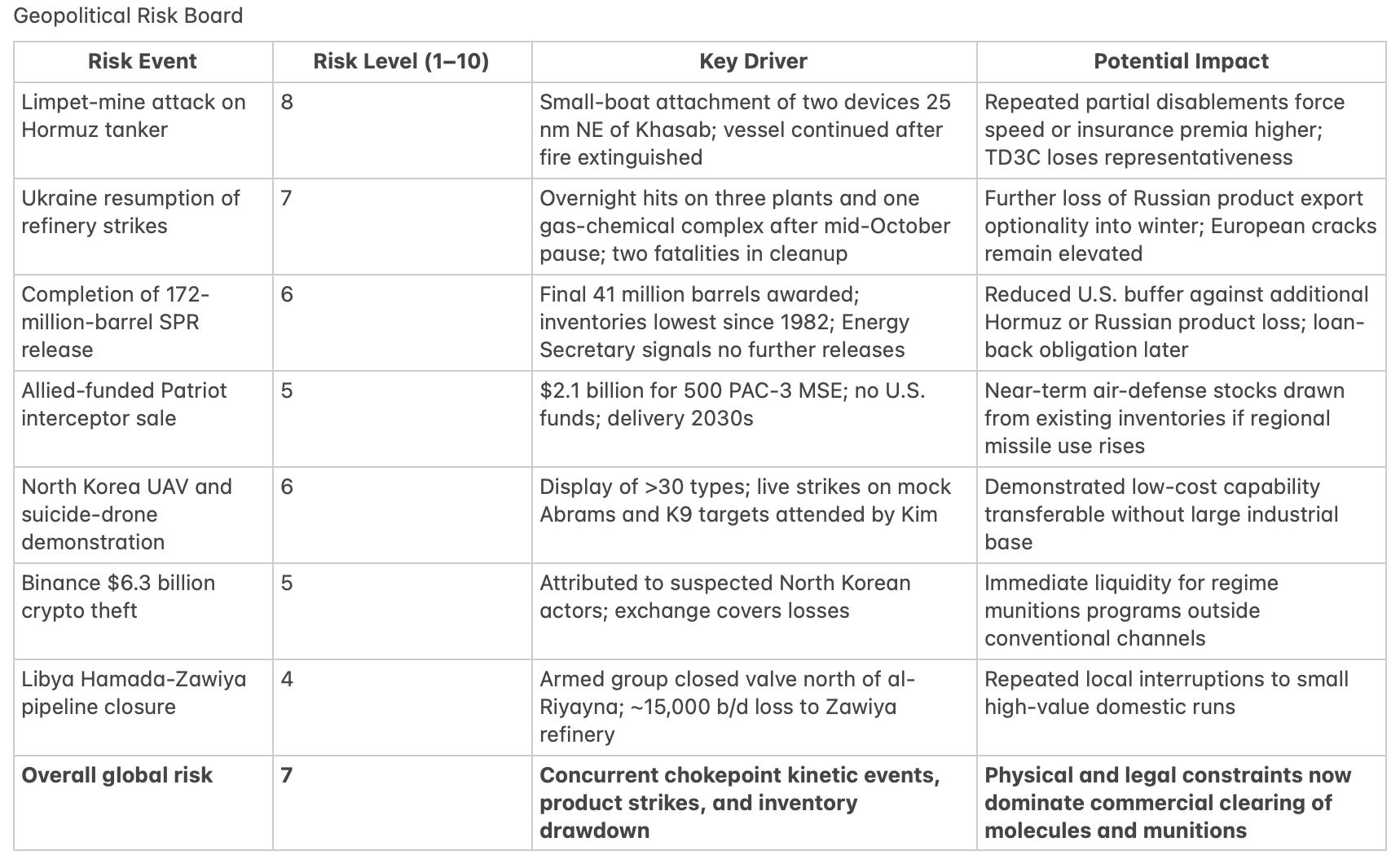
Geopolitical Risk Board
Market Summaries and Why They Move
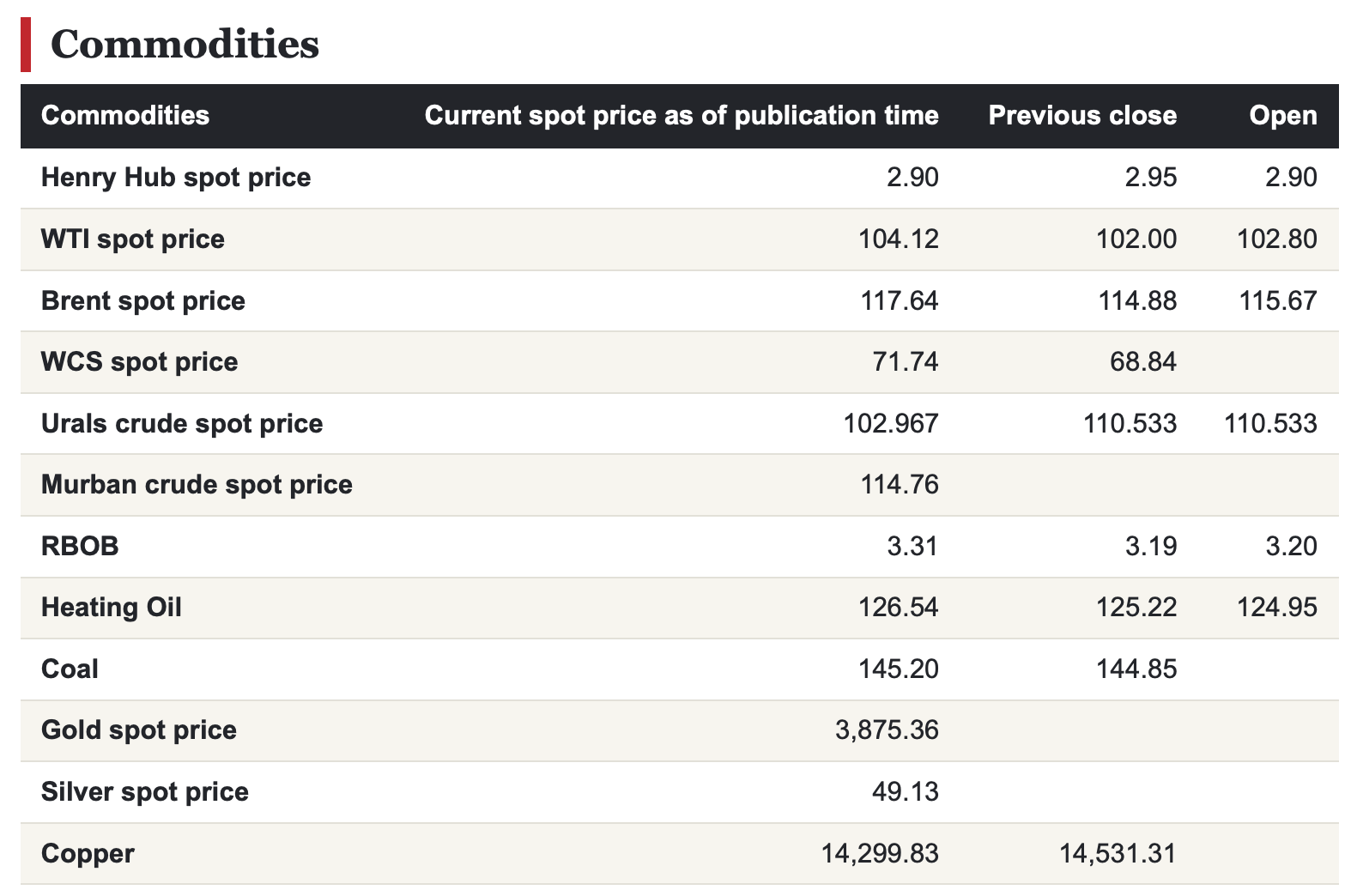
WTI closed near $104.12 and Brent near $117.64 after the limpet-mine incident and the final SPR tranche award, while Urals fell to roughly $102.97 as Ukrainian strikes resumed and the prior unofficial pause ended. The resulting WTI-Urals differential widened on the day while WCS held near $71.74 and Murban near $114.76, reflecting continued preference for non-Russian barrels that can still clear without Hormuz exposure. RBOB and heating oil rose with the crude complex; the gasoline crack and diesel crack both strengthened because Ukrainian strikes remove Russian product export capacity at the same moment European storage sits at 74.89 percent full and TTF gas has topped 101 euros per megawatt-hour. These cracks matter because Europe closed roughly a quarter of its refining capacity over two decades, so any further loss of Russian or Gulf product forces buyers to pay the scarcity rent already captured by remaining U.S. Gulf Coast and European majors.
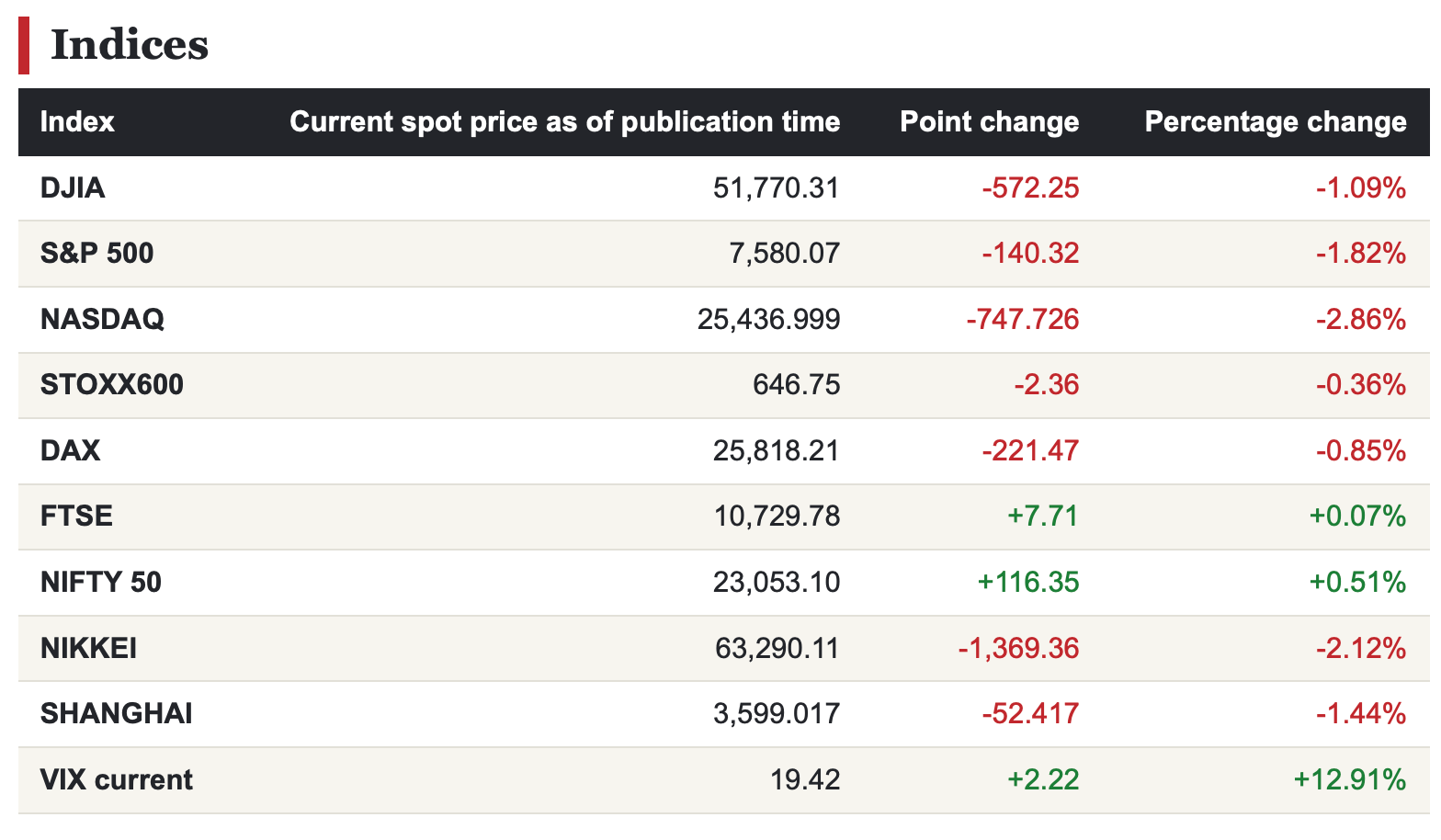
Equity indices declined across the board, with the NASDAQ off 2.86 percent, the S&P 500 off 1.82 percent, and the Nikkei off 2.12 percent, while the VIX rose 12.91 percent to 19.42. Gold held near $3,875 and silver near $49.13; copper eased to roughly $14,300. The equity and metals move tracks the same physical constraints: completion of the SPR release removes a known buffer, the Hormuz mine confirms kinetic risk inside the strait, and the allied Patriot sale with 2030s delivery signals that munitions inventories will not be rebuilt quickly if additional regional strikes occur.
Shipping rates function as the leading indicator. Middle East-to-China VLCC earnings remain near $1.35 million per day after the Louise 1 incident, and whistleblower claims continue against the TD3C benchmark. Tanker rates moved first because physical disablement and insurance premia alter voyage economics before crude prices fully adjust; container rates have not yet shown comparable spikes because the primary disruptions remain in crude and product rather than containerized trade.
In the last 24 hours the confirmed flow changes are the limpet-mine disablement of Louise 1 (continued transit after fire extinguished), the Ukrainian strikes on three Russian refineries and one gas-chemical complex (one facility minor damage), the final 41 million barrels of the 172-million-barrel SPR release awarded to Trafigura and ExxonMobil among others, and the Libya Hamada-Zawiya pipeline valve closure removing approximately 15,000 barrels per day designated for the Zawiya refinery. No large new crude or LNG flows entered the market; Adnoc’s 1.5-million-barrel-per-day West-East bypass remains targeted for 2Q 2027, and the Valero Houston restart of 165,000 barrels per day is scheduled for end-2027.
On industrial commodities, the Brazilian presidential runoff result (Lula over Bolsonaro) and the subsequent legislation allowing a council to review changes of control over mineral assets directly affect the U.S. offtake arrangement for Serra Verde rare-earth output that had been backed by a $750 million Department of War commitment. A reported Chinese rare-earth export restriction has already grounded elements of China’s own aircraft programs, illustrating the dual-use constraint on both sides of the supply chain. No verified last-24-hour price or volume shocks appeared for tungsten, steel, germanium, cobalt, vanadium, molybdenum, titanium, or niobium.
What We Should All Be Watching and Why
The concurrent physical events of the last 24 hours lock the Security-First Energy Regime more tightly. A small boat attached two limpet mines to the Panama-flagged tanker Louise 1 25 nautical miles northeast of Khasab; the resulting engine-room fire was extinguished and the vessel continued, establishing that partial disablement is an achievable outcome inside the Strait of Hormuz. On the same night Ukraine resumed strikes on three Russian refineries and one gas-chemical complex after a mid-October pause, with one facility reporting minor damage and two fatalities during cleanup. The United States awarded the final contracts covering nearly 41 million barrels, completing the 172-million-barrel SPR emergency release under the broader IEA plan and leaving inventories at their lowest level since 1982. These three developments remove both kinetic safety margins at the chokepoint and inventory buffers on the crude side while product export capacity from Russia is again under direct attack.
The most important flashpoints to monitor are therefore the frequency of small-boat or mine attacks in the approaches to Hormuz, the nightly tempo of Ukrainian strikes on Russian refining and gas-chemical capacity, and any further Houthi missile or drone activity against Saudi airports or infrastructure that has already prompted the ordered departure of non-emergency U.S. personnel. Indicators that would signal escalation over the next 7 to 30 days include additional confirmed limpet or mine incidents that force repeated speed reductions or insurance-market withdrawals, a sustained Ukrainian campaign above the three-plant scale, or verified Houthi strikes that close Saudi airports for more than a few hours. De-escalation signals would be an absence of further mine attacks for two consecutive weeks, a renewed pause in Ukrainian energy strikes, or a public statement from the Energy Secretary that SPR barrels will not be called again.
Second-order effects concentrate on optionality. Refiners and traders who locked non-Hormuz crude (Latin America, North America, Mediterranean) in the July-September window retain flexibility; those still configured for Gulf medium-sour grades face multi-week lag times while the Adnoc bypass remains incomplete until at least the second quarter of 2027 and while the Valero Houston restart cannot deliver 165,000 barrels per day before the end of 2027. Policymakers are boxed in by the same constraints: the allied-funded Patriot sale of 500 PAC-3 MSE interceptors carries a 2030s delivery date, so any intensification of regional missile use must be met from existing stocks. The non-energy development of equal geopolitical weight is North Korea’s public demonstration of more than 30 UAV types and live suicide-drone strikes on mock U.S. M1 Abrams tanks. The capability is low-cost, transferable without a large industrial base, and was displayed on the same day a $6.3 billion cryptocurrency theft was attributed to suspected North Korean actors, giving the regime both a demonstrated munition and a fresh funding channel outside conventional sanctions.
Contrarian Take
The limpet-mine attack and the Ukrainian strikes are treated as independent shocks, yet both reduce the volume of molecules that can clear through existing commercial contracts on the same day the final SPR tranche is awarded. Markets are pricing elevated volatility into the U.S. midterms, but the physical constraints (partial disablement inside Hormuz, resumed Russian product loss, lowest SPR since 1982) are already binding and do not require a further policy decision to tighten. The 2030s delivery timeline on the Patriot sale is widely noted, yet the immediate implication is that any additional regional missile consumption must be drawn from stocks that cannot be replenished inside the current heating season. European product cracks at three to 3.7 times year-earlier levels are described as a windfall for remaining majors; they are equally evidence that closed European refining capacity cannot be reversed inside the window of the present disruption. The Binance theft is framed as a crypto-market event; the attribution to suspected North Korean actors places it inside the same munitions-funding channel that the UAV demonstration makes operationally relevant.
Black Swan Analysis
Analysts tracking the Strait of Hormuz note that the Louise 1 incident is the first confirmed successful limpet-mine use since the February war began; a modest increase in the rate of such small-boat attacks could force underwriters to withdraw cover for vessels that cannot demonstrate continuous armed escort, an outcome not yet priced into most forward curves. The North Korean UAV demonstration, combined with the same-day attribution of a multi-billion-dollar crypto theft, raises the possibility that low-cost loitering munitions financed outside conventional channels appear against regional armor or fixed infrastructure faster than existing air-defense stocks can be rotated. China’s reported rare-earth export restriction has already grounded elements of its own aircraft programs; if the Brazilian control-review legislation further delays the Serra Verde offtake, dual shortages could appear in both U.S. and Chinese defense production lines inside a single planning cycle. None of these pathways is the base case in mainstream coverage, yet each rests on events that occurred or were confirmed inside the last 24 hours and on infrastructure or contract timelines that cannot be compressed.
Market Snapshot (Current as to Time of Publication not to be relied upon for trading purposes):

Sources:
Bolsonaro’s Election Defeat Could Complicate U.S. Rare Earth Plans
Jair Bolsonaro lost Brazil’s presidential runoff to Luiz Inácio Lula da Silva and was secretly flown to Miami after defying a Supreme Court order related to a money-laundering case. U.S. rare-earth strategy is now complicated because the Department of War had backed a 15-year offtake of Serra Verde output with $750 million and USA Rare Earth acquired the mine without a clear understanding with Brasília. Lula responded with legislation allowing a new council to review changes of control over mineral assets. Inside the Trump administration, National Security Council officials who favor working with Lula have clashed with State Department officials who backed Bolsonaro, making bargaining over rare earths more difficult. Bolsonaro will lose Senate immunity in February.
Cheniere Deal Marked Only the Start of Qatar’s Global LNG Buying Spree
Cheniere Energy continues to see commercial momentum as buyers seek alternative suppliers amid supply shortages caused by the Iran war and its impact on Middle East LNG output, according to CEO Jack Fusco. The company has loaded a record number of cargoes while the conflict creates opportunities for U.S. exporters. QatarEnergy is developing a new strategy to expand its global LNG portfolio through long-term offtake agreements from other suppliers. This approach is intended to generate revenue even if future exports are disrupted in the Strait of Hormuz. Related reporting indicates that competition for available cargoes is expected to remain elevated into the winter as Europe and Asia compete for limited volumes.
North Korea Turns Mock U.S. Abrams Tanks Into Drone Targets While Displaying Over 30 UAV Types
http://worlddefencenews.blogspot.com/2026/10/north-korea-turns-mock-us-abrams-tanks.html
North Korea displayed more than 30 types of unmanned aerial vehicles at its Unmanned Aeronautical Technology Development-2026 exhibition attended by Kim Jong-un. The display included strategic and tactical multipurpose UAVs, loitering munitions, suicide attack drones, and first-person-view systems. During an accompanying firepower demonstration, suicide drones and other systems struck mock targets resembling South Korean guard posts, K9 howitzers, and U.S. M1 Abrams tanks. Kim called for absolute superiority in drone technology and greater use of artificial intelligence. State media reported that the weapons hit designated targets with claimed high accuracy, while South Korea detected short-range ballistic missile launches the same day.
Tanker in Strait of Hormuz Hit by Limpet Mines, Security Sources Say
https://gcaptain.com/tanker-in-strait-of-hormuz-hit-by-limpet-mines-security-sources-say/
A small boat attached two limpet mines to the hull of the Panama-flagged tanker Louise 1 in the Strait of Hormuz, causing a fire in the engine room and temporarily disabling the vessel. The incident occurred 25 nautical miles northeast of Oman’s Khasab and marks the first known successful use of limpet mines in the waterway since the U.S. war with Iran began in February. The crew was safe, there was no environmental impact, the fire was extinguished, and the tanker continued to its next port. It remains unclear who carried out the attack amid repeated incidents on commercial shipping. The same vessel was previously struck by Ukrainian naval drones in the Black Sea over its alleged role in transporting Russian oil.
Whistleblowers Claimed Key Oil Tanker Rate Was Manipulated
https://gcaptain.com/whistleblowers-claimed-key-oil-tanker-rate-was-manipulated/
The Baltic Exchange has received two whistleblower claims of attempted manipulation of the TD3C tanker rate benchmark since the Iran war began. One claim involving Mercuria and another company was investigated without establishing that the benchmark was manipulated, while a second claim remains under investigation. Mercuria is suing the Baltic, arguing that TD3C should have been suspended because it was no longer representative of actual rates through the Strait of Hormuz. Middle East-to-China tanker earnings have surged from roughly $218,000 a day before the war to $1.35 million. Mercuria held large short positions in TD3C derivatives to hedge its fleet and rejects any allegation of wrongdoing as irrelevant to the case.
Valero to acquire former LyondellBasell Houston oil refinery, restart 165,000 b/d by end-2027
Valero Energy has agreed to acquire LyondellBasell’s shuttered Houston refinery for $320.5 million, including roughly 700 acres on the Houston Ship Channel, 13.5 million barrels of storage, and associated logistics. The company plans to restart 165,000 barrels per day of light sweet crude processing by the end of 2027. The acquisition is expected to ease intermediate feedstock shortages across Valero’s U.S. Gulf Coast system and reduce reliance on third-party purchases. The site sits adjacent to Valero’s existing Houston refinery and could support future investment in heavy sour crude processing. LyondellBasell shut the former 268,000-barrel-per-day plant in March 2025 as part of its exit from refining, and the deal is expected to close by year-end subject to customary conditions.
China’s GJ-21 stealth drone completes first takeoff and landing aboard Type 076 Sichuan amphibious assault ship
http://worlddefencenews.blogspot.com/2026/10/chinas-gj-21-stealth-drone-completes.html
China’s GJ-21 stealth reconnaissance and strike drone has completed its first takeoff and landing aboard the Type 076 amphibious assault ship Sichuan, according to state media. The Sichuan, launched in December 2024, is China’s first Type 076 vessel and is equipped with electromagnetic catapult and arresting systems. Chinese sources describe the test as a breakthrough showing the navy can now operate fixed-wing stealth drones from large maritime platforms. The GJ-21 is characterized as a reusable, relatively low-cost carrier-borne unmanned combat aerial vehicle capable of reconnaissance and strike missions. Analysts note that the Type 076 has thereby demonstrated basic capability as a catapult-capable drone carrier, a development claimed as a global first.
Nigeria to startup up > 80,000 bpd of modular refinery capacity in 2027
Nigeria’s modular refining sector is projected to expand significantly in 2027 with seven new facilities expected to start operations and add a combined 83,000 barrels per day of capacity. The additions would more than double existing modular capacity and increase the role of smaller plants in meeting domestic product demand. The expansion occurs as the country’s refining market shifts due to rising domestic production and changing fuel consumption patterns. Nigerian fuel demand has declined this year partly because of higher pump prices, while the ramp-up of the 700,000-barrel-per-day Dangote refinery is improving self-sufficiency. Steady gasoline output from Dangote is also reducing the competitiveness of European product imports into West Africa.
Reliance looks to Latin America, North America and the Mediterranean as Middle East oil disruptions put supply chains under pressure
Reliance Industries diversified its crude oil sourcing and redirected petroleum product exports during the July–September quarter amid disruptions in the Strait of Hormuz and a temporary shutdown of Saudi Arabia’s East-West pipeline. The company sourced crude from Latin America, North America, and the Mediterranean to keep its refineries operating. Light distillates were redirected to East and South Africa, while middle distillates went to Europe, Latin America, and West Africa depending on netbacks. Reliance also supplied high-speed diesel and motor spirit to domestic customers and public-sector companies without resorting to imports. Transportation-fuel refining margins strengthened sharply, with cracks rising to three to 3.7 times year-earlier levels and reaching historic highs.
Syria Emerging As Products Trade Hotspot
Syria’s Banias port is experiencing its highest trade volumes since the start of the civil war and has effectively become Iraq’s second seaport. After Assad’s fall in December 2024, the new government under President Ahmed al-Sharaa has sought to open access to non-sanctioned markets. The ongoing Hormuz crisis has constrained Iraqi exports from Basra and created opportunities for Banias to handle Iraqi fuel-oil exports and gasoline imports destined for the Iraqi market. These flows are being facilitated by UCC Holding, a Qatari-headquartered and Syrian-owned firm. The shift marks a notable change from Syria’s earlier reliance on Iranian crude and Russian product imports under the previous regime.
Libya’s NOC Warns Of 15,000 b/d Oil Losses Amid Renewed Pipeline Closure
Libya’s National Oil Corporation expressed deep concern after an armed group closed a key valve on the Hamada-Zawiya crude pipeline less than a week after the line recovered from a previous two-day shutdown. The closure occurred just north of al-Riyayna near Zintan and halted flows to the Zawiya refinery. The NOC warned that continued interruption would result in the loss of approximately 15,000 barrels per day of crude designated for the refinery. This is the second such disruption this month, underscoring persistent security risks to Libya’s oil infrastructure. The corporation called on the Petroleum Facilities Guard to help reopen the valve, noting that oil remains the country’s dominant economic resource.
Libya Restarts Brega Refinery, Brings New Gas Field Online
Libya’s National Oil Corporation subsidiary Sirte Oil Company has restarted the Brega refinery after nearly a decade of delays and brought the Rashad gas field online at 50 million cubic feet per day. The refinery restart followed a major overhaul that included catalyst replacement, control-system upgrades, and a new control room. A natural-gas processing unit at the Brega complex was also returned to service after years offline, allowing roughly 60 million cubic feet of gas to enter the national network instead of being flared. The developments were announced during events marking 65 years since Libya’s first crude export from Brega. Officials described the steps as progress in strengthening downstream capacity and reducing gas flaring.
North Koreans Seen as Likely Hackers in Giant Binance Heist
Blockchain intelligence firms and cybersecurity experts have attributed a record $6.3 billion cryptocurrency theft from Binance to suspected North Korean hackers. The group, often linked to operations known as TraderTraitor, has been connected by the FBI and analysts to earlier major heists, including a roughly $1.5 billion attack on Bybit and a $620 million theft in 2022. North Korean actors are widely viewed as among the most prolific and capable state-sponsored crypto thieves, with proceeds reportedly used to support the regime’s weapons programs. The scale of the Binance incident underscores the growing sophistication and reach of these hacking units against major digital-asset platforms.
Russia and Ukraine Evacuate Oleshky: What We Know
https://moderndiplomacy.eu/2026/10/30/russia-and-ukraine-evacuate-oleshky-what-we-know/
Residents of the Russian-held town of Oleshky in southern Ukraine began evacuating on Friday in the first joint Russia-Ukraine humanitarian operation in nearly five years of war. The effort involved coordination linked to U.S. First Lady Melania Trump and Pope Leo and was framed by both sides as a demonstration of commitment to a peace process for President Donald Trump. Moscow and Kyiv continue to hold sharply different positions on ending the conflict, with Russia seeking full control of Donbas and exclusion of Ukraine from NATO while Kyiv wants sustained U.S. military and intelligence support. The operation is limited to the Kherson region and is not expected to produce broader progress. The International Committee of the Red Cross and the United Nations were not asked to participate, though both sides have publicly credited Melania Trump.
Tanker hit by explosives in strait of Hormuz
https://www.argusmedia.com/pages/NewsBody.aspx?id=2897834&menu=yes
A tanker transiting outbound through the Strait of Hormuz was attacked 25 nautical miles northeast of Khasab, Oman, on 29 October when a small boat attached two explosive devices to its hull. The devices detonated, starting a fire in the engine room that temporarily disabled the vessel. All crew members were safe, there was no environmental impact, the fire was extinguished, and the tanker continued to its next port. The incident is the latest in a series of maritime security events in the strait, including other vessel fires and attacks earlier in the month. Iran’s Islamic Revolutionary Guard Corps claimed that three tankers had struck naval mines, though those claims remain unverified. The Joint Maritime Information Centre continues to assess the threat level in the strait as severe.
Adnoc’s new Hormuz bypass seen ready by 2Q 2027
https://www.argusmedia.com/pages/NewsBody.aspx?id=2897787&menu=yes
Abu Dhabi’s Adnoc has told some Asian refiners that its new West-East pipeline bypassing the Strait of Hormuz could become operational by the second quarter of 2027. The 48-inch, 1.5-million-barrel-per-day line, under construction since 2024 and reported nearly 50 percent complete in May, will allow Upper Zakum crude to be lifted from Fujairah. Once complete, combined pipeline capacity to Fujairah is expected to reach about 3.3 million barrels per day, building on the existing Adcop line. The project is intended to give the UAE greater export flexibility while shipping through Hormuz remains severely disrupted. UAE production has already recovered above pre-war levels, unlike many other Gulf producers that have curtailed output.
Binance’s $6.3 Billion Cyber Heist Shows Crypto Vulnerabilities
Binance, the world’s largest cryptocurrency exchange, suffered a cyber attack that affected $6.3 billion in funds, with roughly $3 billion in crypto frozen. The company stated that it will cover all losses, that user funds are safe, and that withdrawals are expected to resume by Sunday while it works with law enforcement and completes a security revamp. Blockchain intelligence firms have attributed the heist to suspected North Korean hackers with high confidence. The incident is described as the largest crypto theft on record and highlights ongoing vulnerabilities in exchange infrastructure. Bloomberg reporting has examined the event as evidence of the growing power and sophistication of state-linked cyber actors targeting digital-asset platforms.
U.S. Awards Last Of Trump’s Massive Strategic Oil Reserve Drawdown
The Trump administration awarded contracts for nearly 41 million barrels from the Strategic Petroleum Reserve, completing a 172-million-barrel emergency release that is the second-largest in the reserve’s history. Trafigura and ExxonMobil were among the recipients of the final tranche. The release forms the U.S. contribution to a broader International Energy Agency plan to place 400 million barrels on global markets after the outbreak of the war with Iran. Rather than a permanent sale, the barrels are being loaned with an obligation for companies to return a larger volume later. The drawdown has pushed SPR inventories to their lowest level since 1982, and Energy Secretary Chris Wright has indicated that further releases are unlikely.
Russia’s Novak Says Ukraine Resumed Refinery Attacks Overnight After Pause
Russian Deputy Prime Minister Alexander Novak said Ukraine resumed attacks on Russian oil infrastructure overnight after a brief pause, striking three refineries and one gas-chemical complex. He stated that one facility suffered minor damage but that air defenses overall performed effectively. The strikes follow an unofficial pause in Ukraine’s campaign against Russian refineries that began in mid-October. Reports indicated a fire at the Novokuybyshevsk refinery in Samara Oblast, with two people killed during cleanup operations. The Kremlin has said the attacks will not derail planned talks, while Washington had previously urged Kyiv to pause strikes on energy facilities to limit further upward pressure on global fuel prices.
Competition For Available LNG Cargoes To Remain Elevated, Says Cheniere
Cheniere Energy expects competition for available LNG cargoes to remain elevated as the Iran war continues to constrain Middle East supplies. CEO Jack Fusco and other executives have noted that the conflict is driving buyers toward reliable alternative sources, including U.S. volumes. The company has raised its full-year earnings outlook on the back of higher export volumes and stronger global spreads. Europe is expected to compete more aggressively with Asia for incremental cargoes heading into winter given low storage levels. Cheniere has indicated that near-term market tightness is likely to persist until constrained Gulf supply recovers more consistently and new global capacity comes online.
Trump Considers Lifting Sanctions on Putin’s ‘Slush Fund’
https://oilprice.com/Geopolitics/Europe/Trump-Considers-Lifting-Sanctions-on-Putins-Slush-Fund.html
The Trump administration is considering lifting sanctions imposed on Russia’s Direct Investment Fund in 2022. The fund, which the U.S. Treasury previously described as a slush fund for President Vladimir Putin, is headed by Kirill Dmitriev, who has become a central figure in U.S.-Russia economic talks. Kremlin officials have confirmed that discussions about unsanctioning the RDIF are underway. Critics argue that removing the restrictions would prioritize American investment in Kremlin-aligned projects without securing meaningful concessions on Ukraine. The fund was established in 2011 to make targeted investments in Russian companies and has partnered with entities including Saudi Arabia’s Public Investment Fund.
European Gas Tops 101 Euros for First Time Since 2022
Europe’s benchmark natural gas price at the Dutch Title Transfer Facility topped 101 euros per megawatt-hour for the first time since the 2022 crisis. The front-month contract rose about 4 percent on Friday and was on track for an 8 percent weekly gain amid fears that Middle East escalation will continue to restrict Qatari and Emirati LNG flows through the Strait of Hormuz. EU storage stood at only 74.89 percent full as of 29 October, well below the five-year average of roughly 86 percent for this time of year. QatarEnergy extended force majeure on LNG deliveries through the end of the year, and unplanned Norwegian outages have added further pressure. Analysts note that disruptions are now extending deeper into the heating season.
America’s LNG Boom Faces Its Biggest Test Yet
https://oilprice.com/Energy/Energy-General/Americas-LNG-Boom-Faces-Its-Biggest-Test-Yet.html
U.S. LNG exports are reaching record levels supported by abundant shale gas, expanding infrastructure, and strong international demand driven by Middle East disruptions. Exports averaged 17.4 billion cubic feet per day in the first half of 2026, 23 percent higher than a year earlier, and the Energy Information Administration forecasts further growth. However, new capacity coming online in Qatar, Canada, and elsewhere later this decade is expected to increase competition. The industry’s next challenge will be ensuring sufficient global demand and high terminal utilization rates to justify multibillion-dollar investments. While geopolitical shocks have boosted the value of flexible U.S. cargoes, long-term demand growth remains sensitive to price and to competing energy sources.
Oil Traders Brace for a Wild Week as Brent Approaches $120
Oil prices are heading for a 13–14 percent monthly gain with ICE Brent trading near $118 per barrel as traders brace for extreme volatility ahead of U.S. midterm elections. Rising numbers of attacks in the Strait of Hormuz, reported explosions at Iran’s Jask port, and signs of military repositioning are overshadowing diplomatic efforts. Markets are pricing in a high risk of renewed U.S.-Iran hostilities in the coming weeks. Additional factors supporting prices include strong refining margins for major oil companies, European strategic reserve releases aimed at cooling diesel prices, and continued supply disruptions. Traders expect a series of highly volatile sessions next week as geopolitical risks remain elevated.
U.S. Oil, Gas Drillers Still on Hold
https://oilprice.com/Energy/Energy-General/US-Oil-Gas-Drillers-Still-on-Hold.html
The total number of active oil and gas drilling rigs in the United States remained unchanged at 603 this week, according to Baker Hughes data. Oil rigs rose by two to 462 while gas rigs fell by two to 130. The Permian Basin count held steady at 272, and the Eagle Ford dipped by one to 50. Weekly U.S. crude production averaged 13.992 million barrels per day in the week ending 23 October, up from the prior week. Primary Vision’s Frac Spread Count fell for a second consecutive week to 194 crews. Oil prices were higher on the day, with Brent near $117.58 and WTI near $104.13.
US orders non-emergency staff to leave Saudi Arabia over security risks
The United States ordered non-emergency government employees and their family members to leave Saudi Arabia effective 23 October because of safety risks, the U.S. embassy in Riyadh said. The decision cited Houthi attacks on civilian airports and other critical infrastructure. U.S. government employees now require special authorization to use Saudi airports following recent missile and drone strikes. The embassy warned American citizens of potential further attacks, airspace closures, flight cancellations, and other travel disruptions. The fighting between Yemen’s Iran-aligned Houthis and the Saudi-led coalition has intensified in recent weeks, opening a volatile new front in the broader regional conflict.
Ukraine gets approval for Patriot missile sale
The U.S. State Department has approved a possible sale of Patriot missile interceptors to Ukraine as part of efforts to strengthen Kyiv’s air defenses against ongoing Russian ballistic missile and drone attacks. This development follows weeks of reported delays in approvals and tensions between Washington and Kyiv over the pace of weapons transfers. Ukrainian President Volodymyr Zelenskyy has repeatedly stressed the urgent need for additional interceptors ahead of winter, noting that existing stocks have run critically low. The approval represents a significant step in allied support, though delivery timelines remain subject to production and logistical constraints.
U.S. Approves Possible $2.1 Billion Allied-Funded Sale of 500 Patriot Missiles to Ukraine
http://worlddefencenews.blogspot.com/2026/10/us-approves-possible-21-billion-allied.html
The U.S. State Department notified Congress of approval for a possible $2.1 billion Foreign Military Sale of 500 PAC-3 Missile Segment Enhancement Patriot interceptors to Ukraine, along with spare parts and logistics support. Ukraine will fund the purchase entirely through contributions from Canada, Germany, and Norway via the JUMPSTART program plus national funds financed by the European Union’s Ukraine Support Loan, with no U.S. government money involved. Lockheed Martin is the principal contractor, and the missiles are new-build systems not expected for delivery until the 2030s. Zelenskyy welcomed the decision but emphasized the need for interim supplies from existing stocks to address immediate winter threats to energy infrastructure.
Dangote Sets Up New Oil and Gas Company in Cameroon
Aliko Dangote has incorporated Dangote Oil & Gas Cameroon SA on October 28, 2026, with initial capital of CFA 10 million and Bertrand Mbouck appointed as CEO. The company is headquartered in Douala’s Bonanjo district with an operations center in the Kribi industrial zone, and its broad mandate covers pipelines, storage depots, marine terminals, refining, petrochemicals, fuel distribution, and gas stations. This scope exceeds the earlier July 2026 proposal for a storage terminal presented to Cameroon’s Prime Minister. The move aligns with Dangote Group’s wider African expansion in downstream infrastructure, including a recent stake in Kenya Pipeline Company and plans for corridors in Namibia and the Horn of Africa.
Substack Articles (not necessarily news but got our attention and provoked us to think)
U.S. Urges Government Employees, Employee Families To Leave Saudi Arabia

The United States ordered non-emergency government employees and their family members to leave Saudi Arabia effective October 23, 2026, because of elevated safety risks from Iranian-aligned Houthi attacks on civilian airports and other critical infrastructure. The U.S. embassy in Riyadh required special authorization for government employees to use any Saudi airports following recent missile and drone strikes that caused civilian casualties and severe travel disruptions. Officials warned American citizens of possible further attacks, airspace closures, flight cancellations, and other interruptions. These steps reflect intensifying fighting between Yemen’s Houthis and the Saudi-led coalition, which has opened a volatile new front in the broader regional conflict involving the United States, Israel, and Iran.
Xi vs Trump on Corruption

Jordan Schneider argues that Xi Jinping treats corruption as an existential threat that could doom the Party and the state, while the Trump family has engaged in open revenue-maximizing after guardrails fell. Xi’s campaign has made outside money dangerous and attached bribes to productive outcomes such as airports, rail lines, chip fabs, and EV plants, even though corruption still lubricates more economic activity in China than in the United States. In contrast, Trump’s approach has produced depleted munitions stockpiles, lost ally trust, and diverted immigrants, with the public now ranking corruption among top voter concerns. Both systems rely on sons and in-laws, yet China’s lack of independent media or voters leaves Xi able only to police the Party internally, as shown by the recent expulsion of 33 officials.
Is Half of China’s AI Making Slop?
Zilan Qian examines the viral claim that AI short dramas and video generation consume 55 percent of China’s AI tokens, a figure traced to a June 2026 investor presentation by COL Group and echoed by a now-unavailable CAICT report. Video generation is extremely token-heavy—one five-second 720p clip can cost around 100,000 tokens—yet calculations based on the roughly 430,000 micro-dramas released in the first eight months of 2026 (over 90 percent AI-produced) suggest they account for only about 7.4 percent of total tokens even under generous assumptions. ByteDance has publicly stated that video generation uses only around 10 percent of its computing capacity. State media rejected the “gunpowder for fireworks” analogy that contrasted alleged U.S. productive use with Chinese entertainment, while Qian links the popularity of “slop” to societal pressure that treats leisure as a personal failing.
Xi Jinping’s Party Purge: Cleaning China’s Sick Forest

Doi Ennoson reports that Xi Jinping framed the October 2026 Fifth Plenum around the metaphor of clearing “sick trees” from the Party forest rather than addressing China’s slowing growth, high youth unemployment, property crisis, or succession planning ahead of the 2027 Party Congress. Attendance fell to roughly 77 percent of Central Committee members, with dozens of absences linked to investigations or expulsions, including senior military figures. Xi has repeatedly warned against “two-faced” cadres who profess loyalty while building personal networks, and investigations remain at high levels. The author contends that constant purges distract from economic causes of distress and suppress orderly succession, recalling late-Soviet patterns in which aging leaders postponed necessary renewal.
10 Insights from the Semiconductor Supply Chain

Claus Aasholm argues that genuine semiconductor insights come from tracking supply-chain signals such as pricing, lead times, and investor-call language rather than hyperscaler sales pitches or internal sales funnels. Nvidia’s revenue has grown roughly 7.4 times and is approaching $100 billion per quarter, while cloud CapEx now covers only about half of total semiconductor revenue after a sharp memory-price surge. Pricing power is spreading beyond AI components, with foundry calls no longer citing mature-node weakness and companies such as Texas Instruments and NXP successfully passing on costs. AI is also transforming “boring” segments, including power semiconductors and optics, where data-center demand is driving 100 percent year-over-year growth and co-packaged optics are entering mass production. The Middle East conflict registers mainly as a cost event that materials and packaging firms are passing downstream.
Trump warns Gulf of imminent Iran blitz as China and Russia rearm Tehran | war news today

Intelligence analyst Ryan McBeth, appearing with Venetia Rainey, discusses U.S. warnings to Gulf governments to prepare for a short, intense post-midterm strike campaign against Iran. New intelligence indicates Tehran has constructed a secret network of companies to rearm with assistance from China and Russia. The conversation examines whether another round of strikes would achieve more than temporary disruption, the status of JD Vance’s back-channel letter to Iranian hardliners, and the risk of depleting U.S. precision munitions such as Patriots and Tomahawks. Additional topics include reported Iranian intelligence operations aimed at the U.S. midterm elections and the recent dismissal of a senior Pentagon general. The episode frames the preparations against the backdrop of ongoing regional hostilities and inventory constraints.
Kurdistan and the coming escalation

Firas Modad assesses that the next phase of U.S. operations against Iran is likely to include activation of Iranian-Kurdish militias based in northern Iraq’s Kurdistan Region alongside large-scale strikes on Iranian infrastructure. Senator Chris Murphy described the reported plan as likely to produce devastating escalation and prolonged conflict, while Senator Ted Cruz advocated arming opposition groups. President Trump’s repeated calls to Turkish President Erdoğan on Republic Day are read as an effort to manage Ankara’s longstanding opposition to Kurdish militia involvement. The analysis links these moves to risks for Kurdistan Regional Government oil exports and Iraqi sovereignty. Overall, the piece anticipates Iranian retaliation across the Gulf and Israel, with civilians in border areas bearing much of the cost.
Europe Closed Its Refineries. Shell, BP And TotalEnergies Just Sent The $28 Billion Bill.

Giacomo Prandelli reports that Shell, TotalEnergies, and BP together posted roughly $28 billion in quarterly profit, driven overwhelmingly by refining margins that soared from single-digit levels to $33–$47 per barrel. Europe has closed about a quarter of its refineries over the past two decades, losing roughly 10–20 percent of capacity, so the continent must import diesel and jet fuel while the Iran war and Ukrainian strikes on Russian plants removed global capacity. The European Commission has labeled the resulting shortage a wake-up call and is discussing temporary fuel-specification relief. None of the world’s ten largest refineries is in Europe, leaving the remaining European majors to capture the scarcity rent. The article notes that capital-allocation choices will determine how much of the windfall reaches shareholders once margins normalize.
Commodity Wrap 30/10/2026 - Gold Below $4,000. Silver Below $50. What Next?

The Contrarian Capitalist notes that gold fell below $4,000 and silver below $50 amid a stronger dollar, a divided Federal Reserve that left open the possibility of further tightening, and possible forced liquidations linked to a Binance security incident. Mining equities tracked the metals lower. Oil and European natural-gas prices retained strength as winter storage stood below historical averages and Middle East tensions limited LNG supply, pushing Dutch TTF gas above €100 per MWh. The piece highlights Hong Kong’s planned tokenization and collateralization of physical gold and silver as a longer-term liquidity development that could support physical demand. Overall, the author expects continued volatility in precious metals while energy markets remain supported by supply disruptions.
AI: Anthropic’s S-1, the Cloud Gang Reports, OpenAI’s Price Push & More. AI-RTZ #1256

Anthropic filed its S-1 for a Nasdaq IPO under ticker ANT, with quarterly revenue rising from $376 million early in 2025 to $11.6 billion in Q2 2026 and a first operating profit of $974 million as compute costs fell sharply. The prospectus disclosed nearly $800 billion in compute commitments and an addressable market above $40 trillion. OpenAI has offered discounts of 30-40 percent that shifted business from Anthropic at clients such as Rippling and Replit. Google’s results disappointed due to slowing search growth and massive AI commitments exceeding $1 trillion, whereas Microsoft’s Azure expansion and commercial backlog growth drew positive investor response.
The China 5: Command, Capital, Correction
A $3.5 trillion sell-off wiped out Chinese technology and AI equity values as the CSI 300 entered a bear market despite state-backed ETF purchases that reallocated rather than added liquidity. Arab crude outflows recovered to roughly 80 percent of pre-war volumes including Red Sea bypasses, but detours trapped one to two billion barrels in transit and drove inventories below ten-year lows. Oxford Economics revised projections so China’s nominal GDP reaches just 84 percent of the United States by 2040, ending prior overtake forecasts. The Fifth Plenum convened with 34 members absent amid purges, youth unemployment hit 18 percent, and a rare-earth export ban backfired by grounding China’s own aircraft programs.
DC Update From the U.S. Oil & Gas Association - 10.30.2026: Election Day Is Upon Us

Forecast models show Democrats with an 80-97 percent probability of flipping the House into a 230-241 seat majority, although Nate Silver notes that 3-4 point systematic errors could leave Republicans controlling the Senate or produce a 50-50 outcome. Democrats are split over the Senate permitting reform bill, as Podesta and the NRDC argue it hands Trump excessive leverage while Steyer and Granholm urge passage for project certainty. The EPA proposed changes to the Biden methane rule that restore flaring options, rescind the super-emitter program, and set separate standards for marginal wells under 15 barrels per day. Under Speaker Jeffries an affordability package would likely include E15 support and efficiency credits, while Europe’s energy chief called the current winter crisis worse than 2022 with 50 million unable to heat homes.
Community Notes:
There are over 24,000+ daily readers of this daily Rapid Read
We are very happy to announce that we have a YouTube page.
PLEASE go to www.YouTube.com/@GeopoliticsUnpluggedRapidRead and SUBSCRIBE.
We have over 2000 subscribers on YouTube
What you through subscribing have helped to fund and will fund in terms of charitable flying:
PAST MISSIONS
On April 23, 2026, I transported a 64 year old male with brittle bone and cancer complications from his home in Wilkes-Barre (KWBW) to his treatment at U Penn in Philadelphia flying into Wings Field (KLOM)
On May 5, 2026, I transported a 40 year old female with a brain tumor from Harrisburg, PA (KCXY) to her surgery at the Cleveland Clinic flying into (KLPR).
On July 1, 2026, I flew 18 month old Liam from his home in Altoona (KAOO) to the Children’s Hospital of Philadelphia flying into Wings Field (KLOM)
On July 7, 2026, I flew from KBED to KCXY with a 36 year old female patient with Metastatic Adenoid Cystic Carcinoma. Together with your support we got her home from her cancer treatment at Dana-Farber Cancer Institute in Massachusetts.
On August 11, 2026 I transported a 49 year old female with Stage 4 metastatic colon cancer to the NIH Clinical Center for life extending treatment and clinical trials there. KPTW -> KGAI
On August 18, 2026 I flew a male with prostate cancer. Together with your support we got him to life saving treatment at Memorial Sloan Kettering Cancer Center in Manhattan. KELM -> KTEB
On September 24, 2026, Sophia and I transported a 82 year old cancer patient from York, PA (KTHV) to Wilmington, NC (KILM) for her life saving treatment.
On October 1, 2026, Nicole and I transported a 6 year old patient and his family who just had complete airway reconstruction back to his care provider for his 3 month post operative check up from Philadelphia to Columbus, OH. KKPNE -> KLUK
On October 14, 2026, Christian and I transported a 49 year old female with Stage 4 metastatic colon cancer to the NIH Clinical Center for life extending treatment and clinical trials there. KPTW -> KGAI
FUTURE FLIGHTS
On November 12, 2026, Jake and I are transporting a 23 year old woman fighting a rare form of liver cancer to Oswego County Airport (KFZY) to Westchester County Airport (KHPN), so she can get to her appointment at Memorial Sloan Kettering in New York City.
On November 17, 2026, Foster and I are transporting a 41 year old female with cancer from Martin State Airport (KMTN) to Raleigh-Durham International Airport (KRDU), flying her home after her medical appointment. This is a SkyHope mission.
On November 19, 2026, Dave and I are transporting a 12 pound newborn baby with Prader Willi Syndrome and his parents from Philadelphia to South Hill, VA as part of a trip to get this baby in need to the University of Florida for care. KLOM -> KAVC
On December 1, 2026, Cheyenne and I will be flying a 35 year old female patient back home who had a surgical consultation at Penn Medicine. I will be flying from Wings Field (KLOM) outside Philadelphia to Burke Lakefront (KBKL) in Cleveland, OH.
On December 15, 2026, Foster and I will be flying a 55 year old total ankle replacement patient home from treatment at Johns Hopkins flying out of Martin State Airport (KMTN) to his home area at Binghamton, NY (KBGM). This is a SkyHope mission.


